Courses

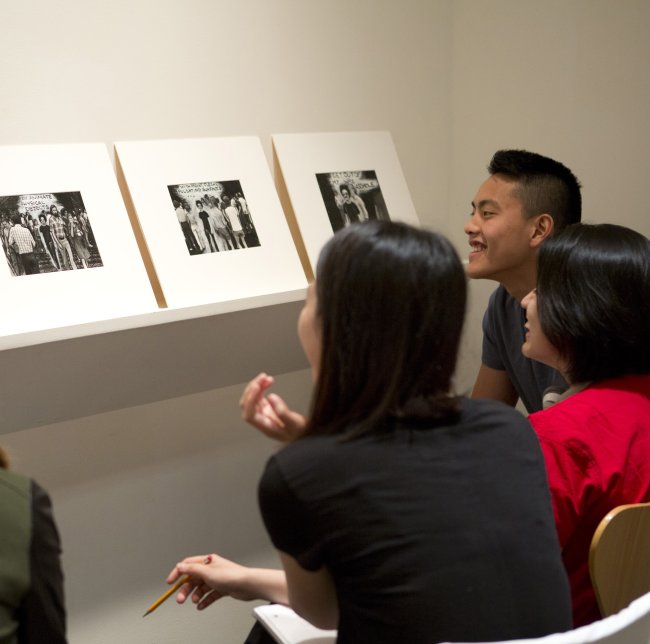
Explore the undergraduate course offerings in art history, including cross-listed classes and college core classes offered by art history faculty. Much of the coursework offered by art history faculty encourages direct engagement with art historical sources and original works of art, taking advantage of the resources of the Smart Museum and other art institutions in Chicago and beyond. Part of the Rhoades Exchange Program, the annual Rhoades Seminar is taught by a curator at the Art Institute. The Suzanne Deal Booth Conservation Seminars are offered by a conservator or conservation scientist based at the Art Institute. Gold-Gorvy Traveling Seminars involve class travel to work with objects, buildings, and sites first hand.
Undergraduate courses are numbered 10000-29999. 100-level courses satisfy Arts Core requirements, while 200-level courses fulfill major and minor requirements.  Courses of study should be developed after consulting the catalog for required classes and conferring with the advisor and/or Director of Undergraduate Studies.

Undergraduate Courses

ARCH 11000
Architecture, Drawing, and Design

Drawing has shaped architecture for centuries. This course introduces students to architecture through the practice and critical discussion of drawing. Studio exercises will introduce media ranging from hand-sketching to digital modeling; representational conventions such as plans, sections, and diagrams; and the roles of drawings as creative tools and conveyors of ideas, visions, and technical information. Students will engage with historical and contemporary precedents, with fundamental texts about architecture and drawing, and with the built environment on campus and in Chicago

This course meets the general education requirement in the arts.

2026-2027
Spring

ARCH 11000
Architecture, Drawing, and Design

This course meets the general education requirement in the arts.

Drawing has shaped architecture for centuries. This course introduces students to architecture through the practice and critical discussion of drawing. Studio exercises will introduce media ranging from hand-sketching to digital modeling; representational conventions such as plans, sections, and diagrams; and the roles of drawings as creative tools and conveyors of ideas, visions, and technical information. Students will engage with historical and contemporary precedents, with fundamental texts about architecture and drawing, and with the built environment on campus and in Chicago.

This course meets the general education requirement in the arts.

2026-2027
Autumn

ARCH 11000
Architecture, Drawing, and Design

This course meets the general education requirement in the arts.

Drawing has shaped architecture for centuries. This course introduces students to architecture through the practice and critical discussion of drawing. Studio exercises will introduce media ranging from hand-sketching to digital modeling; representational conventions such as plans, sections, and diagrams; and the roles of drawings as creative tools and conveyors of ideas, visions, and technical information. Students will engage with historical and contemporary precedents, with fundamental texts about architecture and drawing, and with the built environment on campus and in Chicago

This course meets the general education requirement in the arts.

2026-2027
Winter

ARCH 24181
/
ARTH 34181
Introductory Architecture Studio: House, Housing

(
ARTH, CEGU
)
Introductory Architecture Studios introduce students to technical skills and creative approaches for designing the built environment. While exploring different themes, the cumulative design exercises of these studios prepare students for Advanced Architecture Studios. No prior studio or art experience is required.

This introductory studio focuses on housing as an entry point to architectural design. Students will learn fundamental skills, including analog and digital drawing, model making, and spatial thinking. Focusing on designing for vacant lots in Chicago neighborhoods, students will explore housing typologies, such as two-flats and multi-family buildings, analyze historical and contemporary precedents, and ultimately develop their own proposals for repeatable housing models that serve future needs.                   
The course introduces fundamental design concepts, including scale, circulation, and spatial relationships, as well as first principles around structural systems and building materials. It also explores, through readings and discussions, innovation in these topics at a global scale. Through cumulative short design exercises, students study how housing typologies can respond to and shape social, ecological, and cultural contexts, increase affordability and access, and produce community. 
Students will participate in field trips to notable Chicago residential projects and meet with practitioners, builders, and developers. The course will introduce students to design and also use housing as a lens through which to understand architecture’s role in both shaping cities and everyday life.

2026-2027
Winter

ARCH 24205
/
ARTH 34205
Introductory Architecture Studio: Skills & Processes

(
CEGU, ARTV
)
Introductory Architecture Studios introduce students to technical skills and creative approaches for designing the built environment. While exploring different themes, the cumulative design exercises of these studios prepare students for Advanced Architecture Studios. No prior studio or art experience is required

This studio course acquaints students with skills and methods in architectural design. By focusing on one or more design projects, student will learn analog, digital and hybrid formats, processes of revising and refining, responding to site and context, and considering historical research and precedent. This is an introductory course for any student interested in architecture with no prior skills required. 

2026-2027
Spring

ARCH 24205
/
ARTH 34205
Introductory Architecture Studio: Skills & Processes

(
DOVA, CEGU
)
Introductory Architecture Studios introduce students to technical skills and creative approaches for designing the built environment. While exploring different themes, the cumulative design exercises of these studios prepare students for Advanced Architecture Studios. No prior studio or art experience is required.

This studio course acquaints students with skills and methods in architectural design. By focusing on one or more design projects, student will learn analog, digital and hybrid formats, processes of revising and refining, responding to site and context, and considering historical research and precedent. This is an introductory course for any student interested in architecture with no prior skills required. 


2026-2027
Autumn

ARCH 26510
/
ARTH 34210
Advanced Architecture Studio: Complex Curves/Plastic Shapes

(
ARTH
)
Experience with the arts or design is recommended. Advanced Architecture Studios engage deeply with specific topics in the built environment, architectural and design practice, or representation. Students should have completed at least one introductory Architecture Studio before enrolling

This course examines the design and construction of “plastic shapes” in 20th century art and architecture. Investigation begins by study of several mid-20th century artists, including Gabo, Albers, Moholy-Nagy, Arp, and Hepworth, all of whom had deep architectural interests. Investigation is done of their spatial organization of three-dimensional forms, and these studies inform your own drawings and models. Throughout the quarter, work grows in both control and complexity, and is done in both orthogonal and curvilinear geometries. Issues studied include regulatory lines, boundary conditions, transparency, and shallow and deep space. Modeling is done with software, ending in the making of three-dimensional objects. The formal discipline learned has wide application, for intimate spaces as well as larger architectural landscapes. Recommended: familiarity with any design processes and active engagement in class.

2026-2027
Winter

ARCH 27022
/
ARTH 37022
Advanced Architecture Studio: Material Narratives

(
ARTH, ARTV, CEGU, CHST
)
Advanced Architecture Studios engage deeply with specific topics in the built environment, architectural and design practice, or representation. Students should have completed at least one introductory Architecture Studio before enrolling

This studio explores architecture and design thinking through the lens of building materials--brick, stone, wood, metal, concrete, glass, and sustainable materials. Our focus will be on how designers and architects think about materials, how they use them in their work, and how materials can play a principal role in the design process. This will serve as the foundation for our design project--to design a pavilion somewhere on campus.

2026-2027
Spring

ARCH 27202
/
ARTH 37205
Advanced Architecture Studio: The Next Chicago School

(
ARTH
)
Advanced Architecture Studios engage deeply with specific topics in the built environment, architectural and design practice, or representation. Students should have completed at least one introductory Architecture Studio before enrolling

What should a design curriculum be today? How might a new facility on the University of Chicago campus sustain design education, advance research, support production, and serve as a center for conversation? The Next Chicago School invites students to develop two parallel proposals: (a) a speculative design curriculum and (b) an architectural proposal for a new facility to support design research, collaboration, and education.

Organized as a hybrid seminar and studio, the course supports student proposals through an examination of the ideological frameworks that have shaped architectural and urban design discourse, paying particular attention to how socio-cultural, political, ecological, and economic conditions have precipitated radical change.  Focusing on the twentieth and twenty-first centuries as periods marked by disruption and conflict, the seminar considers how these conditions have produced ruptures in historical continuity for designers and artists.  Within this context, the term “Chicago School” refers to multiple, distinct intellectual formations associated with the city of Chicago and the University.  In parallel, the studio speculates on the transformation of the Campus North Garage into a facility capable of supporting proposed educational models. Students will develop architectural proposals as material and infrastructural support, gain familiarity with influential paradigms in architectural history, and develop fluency in a range of techniques for design production, inquiry, and communication

This course fulfills the following requirements in the ARTH major and minor: European and American, modern (post-1800)

2026-2027
Spring

ARCH 27308
/
ARCH 37308
Advanced Architecture Studio: Future City, Chicago Year 2137

(
CEGU
)
Advanced Architecture Studios: Advanced Architecture Studios engage deeply with specific topics in the built environment, architectural and design practice, or representation. Students should have completed at least one introductory Architecture Studio before enrolling

This studio imagines the future city of Chicago two centuries after its founding, to create visions of how climate change, migration, shifting mobility patterns, and economic and demographic transformations have the potential to literally reshape urban life. Students will engage in speculative design by asking “What if: X?”—using hypothetical scenarios to test the limits of architecture and urbanism. The course takes a multi-scalar design approach, from imagining  transformations in everyday objects like a cup of coffee to re-visioning infrastructure, public space, or cultural institutions, connecting personal experience with city- and region-wide systems.

The studio will combine data-driven analysis, including introducing students to GIS mapping to present geospatial information, with speculative approaches inspired by science fiction in novels and films, translated into digital image making. Students will develop visual narratives that catalyze conversations about future urban conditions, with areas of focus of their choosing. The studio is complemented by a lecture series featuring future-oriented architects and designers in adjacent disciplines, introducing ways that speculative thinking can produce new conversations on modes of climate adaptation, social resilience, and emerging technologies at the city-scale. 
 

2026-2027
Spring

ARCH 27412
/
ARTH 37412
Design as Advocacy: Housing

(
ARTH, CEGU
)

This course positions the architect as an advocate, engaging the building and zoning code as a critical site of design practice in addressing the housing crisis. Rather than treating regulation as a constraint, students will examine how architects can shape policy to expand housing supply, affordability, and typological breadth. Focusing on “missing middle” housing, the course investigates how provisions—such as egress requirements, parking requirements, and unit standards—shape the production of housing, inclusive design, alongside emerging nation-wide movements such as the expansion of ADUs.

Through readings, case studies, and conversations with policymakers, attorneys, and designers, students will develop strategies for advocacy as a form of design work. Working in groups and individually, they will produce targeted code reform proposals that connect spatial thinking and design with regulatory change. The course culminates in three-minute public comment presentations at a City Council committee, where students test their arguments in a live civic forum, positioning architectural practice as an active agent in shaping housing policy.
 

2026-2027
Autumn

ARCH 27451
/
ARTH 37451
Advanced Architecture Studio: Ancestral Wisdoms for Climate Futures

Advanced Architecture Studios engage deeply with specific topics in the built environment, architectural and design practice, or representation. Students should have completed at least one introductory Architecture Studio before enrolling.

What can ancestral building wisdom teach us about living with climate change today? If many traditional buildings were already climate-responsive, what have contemporary building practices forgotten? In this architecture research studio, we explore how Indigenous structures from around the world embody long-standing relationships between climate, materials, landscape, and cultural practice; and consider how this knowledge can inform living environments today. 
Through case studies and drawing as our primary mode of inquiry and communication, we will examine global architectural traditions alongside the ecological and cultural contexts that shaped them. While the course centers architectural systems that support human comfort, we will also engage the cultural frameworks, recognizing that climate knowledge is embedded within broader social worlds. 
Students will analyze passive strategies for thermal comfort and represent their findings through analytical drawings. Over the course of the quarter, the studies form a collective visual compendium, documenting environmental systems across diverse Indigenous building traditions.
The shared research becomes a lens for reviewing contemporary conditions in the latter part of the quarter. Students will consider climate change and explore how ancestral building knowledge might inform adaptations to everyday structures in the city.

2026-2027
Winter

ARTH 10100
Introduction to Art

Students must attend first class to confirm enrollment.

This course develops skills in perception, comprehension, and evaluation of various art objects and the built environment. It encourages close analysis of visual materials, exploring the range of questions and methods appropriate to works of art and buildings, in their historical, theoretical, and social dimensions. Most importantly, the course emphasizes articulate writing and salient argumentation about visual and other aesthetic phenomena. Three coherent units, on Monument/Site, Image/Medium, and Object/Museum, explore these issues across cultures and periods. Examples draw on original objects in campus collections and sites on campus.

This course fulfills the following requirements in the ARTH major and minor: Theory and Methodology

This course meets the general education requirement in the arts.

2026-2027
Spring

ARTH 14400
Italian Renaissance Art

Why did the “Renaissance” begin to flourish in Italy? How did the role of the artist change in this period? What was new in the Renaissance? This course begins to answer these questions by introducing students to the study of the visual culture of Renaissance Italy (roughly 1350-1600) and by examining issues such as the interest in antiquity, the significance of the study of nature, the role of competition, the public and private displays of art, and global expansion.  We will explore a variety of media including painting, sculpture, architecture, decorative arts and works on paper, using diverse art historical methods, as well as social, political and religious history. Major artists to be studied include: Giotto, Ghiberti, Donatello, Masaccio, Botticelli, Leonardo da Vinci, Michelangelo, Raphael, Titian.

This course fulfills the following requirements in the ARTH major and minor: European and American, pre-modern (pre-1800)

This course meets the general education requirement in the arts.

2026-2027
Spring

ARTH 14413
Global Pop

When you hear the words “Pop Art,” what comes to mind? Soup cans, comic book panels,  portraits of Marilyn Monroe, enormous paper clips? These are some of the most iconic examples of Pop Art made in the United States. Since the 1960s, artists around the world have also explored art’s relationship to mass media, consumerism, and representation. This course will examine the work of artists outside of the Euro-American canon who have employed Pop Art strategies. We will cover a wide geographic and temporal expanse, with a special focus on Latin America, and including as well art from East Asia, Africa, and the Middle East. 

We will consider how artists have employed Pop Art to both challenge and engage with artistic tradition in their respective countries; probe issues of national and personal identity; intervene in political conversations; question semantic and representational certainties; foster new kinds of relationships between art and its viewers; and reflect critically on their media environments. 


This course fulfills the following requirements in the ARTH major and minor: European and American post-1800

This course meets the general education requirement in the arts.

2026-2027
Autumn

ARTH 15631
Intro South Asian Art and Architecture I

This core class introduces students to the visual arts of early South Asia (Paleolithic period to circa first millennium CE). During this time period, South Asia gave birth to three major world religions—Hinduism, Jainism, and Buddhism. Christianity and Islam too made it to South Asia and the arts of these religious traditions flourished in various pockets of the Indian subcontinent. In the class, we will look at paintings, buildings, and other objects that continue to beguile researchers, such as the paintings of Bhimbetka Caves (ca. 10,000 BCE); the enigmatic seals from Indus Valley (ca. 2000 BCE), and the high polish of Mauryan sculptures. The latter-half of the course is devoted to specific studies on “masterpieces” of early Indian art, such as the Buddhist stupas at Sanchi (ca. third to first cent. BCE), the extraordinary rock-cut temples of Ajanta and Ellora (fifth to thirteenth centuries), and the sizeable and distinctive temple complex of Bodh Gaya, Khajuraho, Mamallapuram, and Brihadeshwara (seventh to eleventh centuries). The course will explore many themes in the study of early South Asian art; some prominent ones are the role of politics, nature, and religion in shaping artistic practices. Conversely, we will also look at how artistic practices impacted civic institutions and religious organizations, while exploring what art can reveal about how natural resources were viewed, extracted, and preserved in early South Asia.
 

This course fulfills the following requirements in the ARTH major and minor: Asian, premodern (pre-1800)

2026-2027
Autumn

ARTH 15635
Introduction to South Asian Art and Architecture: Latter South Asia (Part II)

(
ARCH, SALC
)

This core class will pick up the narrative thread from “Introduction to South Asian Art: Early South Asia (Part I),” although taking that course was not a pre-requisite. In this class, we will cover the period that I call, for the sake of convenience, “Latter South Asian,” i.e., from about the turn of the first millennium to the present day. During the period covered in this class, we will explore the formation and the arts of the early Islamic political powers in South Asia and their adoption of Indic practices. Equally, we will explore how Hindu courts and artistic traditions responded to Islamic presence. Towards the latter half of the course, we will look at the arrival of colonial powers and their impact on South Asia’s artistic traditions, and finally, to the issues of nationalism and globalism in the last two centuries. Art making and architectural practice responded to these historical, political, religious, and cultural shifts, and this class will examine what the visual art from South Asia can teach us about its complex “latter” history.
 

This course fulfills the following requirements in the ARTH major and minor: Asian, modern (post-1800), Asian, premodern (pre-1800)

This course meets the general education requirement in the arts.

2026-2027
Spring

ARTH 15636
Modern Korean Art

This course introduces students to key histories, artworks, and theoretical discourses surrounding modern Korean art. Covering the period from the late 19th to mid-20th century, the course explores historical junctures—late Joseon, the Korean Empire (1897–1910), the colonial period (1910–1945), and the Korean War (1950–1953)—as critical moments during which the concepts of modernity and "modern art" (geundae misul) were imported and contested. Beyond providing a basic understanding of modern Korean art history, the course engages with broader art-historical inquiries, particularly how modernity and modernism can be articulated within a global framework. Readings encompass art historical texts as well as theories on multiple modernities, global modernisms, theories of imperialism, and decoloniality. Discussion sections will emphasize the close reading of texts and visual materials, including drawings, paintings (oil and ink), photography, sculpture, and architecture.

This course fulfills the following requirements in the ARTH major and minor: Asian, modern (post-1800), Theory and Historiography

This course meets the general education requirement in the arts.

2026-2027
Winter

ARTH 15705
Introduction to the Built Environment

(
ARCH, CHST
)

This course aims to equip students with the basic skills and knowledge required to analyze architecture and the built environment. It offers an introduction to the methods and procedures of the architectural historian. These include practical tasks such as understanding architectural terminology, reading and interpreting architectural drawings, engaging with buildings “on site,” and studying buildings in context through urban design issues, such as street networks and surrounding context. At a broader level, the course will entail critical discussion about the relationship between architecture and society, the building as a historical object and an object that changes over time, cultural representation of architecture, and modes of perceiving/experiencing the built environment.

The course format is a discussion seminar based on readings, assignments, and field trips. Thematic seminars in the classroom are complemented by visits to buildings, sites, special collections, and architectural firms, offering a theoretical and practical introduction to the built environment as both an object of study and a tool for socio-historical analysis.

This foundational course for the undergraduate Architectural Studies minor program is offered once each year, and is available to minors, prospective minors, and other interested students, including graduate students. 
https://arthistory.uchicago.edu/undergraduate/architectural-studies 

This course fulfills the following requirements in the ARTH major and minor: Theory and Historiography 

This course meets the general education requirement in the arts.

2026-2027
Autumn

ARTH 15780
Western Modern Art from the Enlightenment until Today

This course meets the general education requirement in the arts. Discussion groups will meet as arranged on Thursdays and Fridays.

This course teaches skills of looking at and understanding visual art with a focus on modern art made in Europe and North America from the 18th through the 21st century. Students will learn about movements such as Impressionism, Surrealism, and Pop; artists including Pablo Picasso, Jackson Pollock, and Jenny Holzer; and issues central to the relationship between art and modernity: definitions of the self and identity, the emergences of the metropolis and the art market, the "real" and the invention of photography, meanings of abstraction and non-traditional materials, the political ambitions of the avant-garde, consumption and media. Discussion sections center around original artworks in the Smart Museum of Art and the University’s Public Art and Special Collections.

This course fulfills the following requirements in the ARTH major and minor: European and American post-1800. 

This course meets the general education requirement in the arts.

2026-2027
Winter

ARTH 15800
Contemporary Art

(
ARTV
)

This course concentrates on the practice and theory of visual art over the course of the twentieth and twenty-first centuries. Among the subjects that will drive our narrative will be the rise (and decline) of modernism, art in the postcolonial era, pop art, the aesthetics of social movements, the relationship between popular media and feminism, the concept of spectacle, conceptual art, the appearance of a global art industry after 1989, the connections between art school and art-making, “relational aesthetics,” the fate of art in the age of the Internet, art and AI, the art of the post-studio moment, and what happens to art when it engages with “everything.”

This course fulfills the following requirements in the ARTH major and minor: European and American, modern (post-1800), Theory and Historiography

This course meets the general education requirement in the arts.

2026-2027
Spring

ARTH 16100
Art of the East: China

(
EALC
)
Students must attend first class to confirm enrollment. This course meets the general education requirement in the arts.

This course is an introduction to the arts of China focusing on the bronze vessels of the Shang and Zhou dynasties, the Chinese appropriation of the Buddha image, and the evolution of landscape and figure painting traditions. This course considers objects in contexts (from the archaeological sites from which they were unearthed to the material culture that surrounded them) to reconstruct the functions and the meanings of objects, and to better understand Chinese culture through the objects it produced.

This course fulfills the following requirements in the ARTH major and minor: Asian, premodern (pre-1800)

2026-2027
Winter

ARTH 16460
Modern Latin American Art

(
LACS
)

This course investigates the development of Latin American art from the early nineteenth century to the present. Through the study of representative artists, movements, and works, we will trace this history from the formation of art academies in newly independent Latin American nations through the region's rise to prominence in an increasingly global art world. Although we will adhere to a roughly chronological organization, a set of key themes and debates will likewise structure our investigation. Among them are: the formation of collective identities (and the intersections of race, class, and nation); the impact of social and political revolutions and counter-revolutions on artistic practices; the reception and adaptation of indigenous and European (and later U.S.) art practices; and the various national, regional, and global frameworks that have been used to think through the specificity of art production from Latin America. Special emphasis will be placed on developing the skills needed to analyze a wide variety of modern and contemporary art, including painting, sculpture, photography, performance art, and site-specific installations.

This course fulfills the following requirements in the ARTH major and minor: Latin American

This course meets the general education requirement in the arts.

2026-2027
Spring

ARTH 17201
Art in the Age of Computation

This course explores how artists have engaged with computation—not only as a technology, but as a way of thinking about systems, information, thought, and perception—from the mid-twentieth century to the present. We consider how cybernetics and systems thinking helped reconfigure the work of art and visual perception; collectives that sought to institutionalize collaborations between artists and engineers; art in the age of nuclear energy, space exploration, and global telecommunications; as well as contemporary creative and critical responses to AI. Students will engage in close study of key artworks through lectures, discussions, and visits to local art collections. Discussions and short assignments will help students to situate artworks within broader historical, technological, and aesthetic contexts. 

This course fulfills the following requirements in the ARTH major and minor: European and American, modern (post-1800)

This course meets the general education requirement in the arts.

2026-2027
Autumn

ARTH 17209
Art in France, 1598-1666

The modern art world, based on saleable commodities, state bureaucracy and academic infrastructure, emerged in France in the 1600s. This course will survey the art of this period by digging into the careers of individual artists—some well known (like Nicolas Poussin), others obscure (like Louise Moillon).  Secondary topics will include: the rise of the New Science (Descartes); the relationship between spirituality and knowledge (Pascal, Montaigne); and the emergence of an absolutist State (Versailles, the Academy). Readings will be drawn largely from primary sources, all in translation.  Enrollment will require you to make trips to the Art Institute of Chicago to complete assignments.

This course fulfills the following requirements in the ARTH major and minor: European and American, pre-modern (pre-1800)

This course meets the general education requirement in the arts.

2026-2027
Spring

ARTH 17307
Death and Dying in the Middle Ages

This course will explore the relationship between the visual arts and culture of death in the western Middle Ages. Death did not mark a firm end for medieval people, whose daily lives included ideas about the Resurrection, revenants, and saints – a special class of holy undead. We will turn to the visual arts as a privileged medium for commemorating and caring for the dead in order to chart changing conceptions of death and the afterlife from roughly the third century to 1500 CE. We will study a variety of works of art, from manuscripts to sculptures, textiles to poems, drawn from different regions throughout medieval Europe. Examining primary sources (in translation) and relevant secondary literature, students will hone their abilities to comprehend the past through historical objects and to understand the particular role that works of art played in mediating the relationships between the living and the dead. Special topics include reliquaries, necromancy, the Apocalypse, and the Black Death. 

This course fulfills the following requirements in the ARTH major and minor: European and American, pre-modern (pre-1800)

This course meets the general education requirement in the arts.

2026-2027
Autumn

ARTH 17602
Contemporary Art Beyond Korea

This course surveys key histories and theoretical discourses surrounding contemporary Korean art. While taking a roughly chronological approach – beginning at the end of the Korean War (1950-1953) and extending to the present day – the course also perceives “Korea” as a spatial imaginary and field of inquiry that lies beyond the nation-state. Korea, from the aftermath of the Korean War onwards, served as a significant testing ground for the Cold War restructuring of the global economy. Parallel postwar histories – industrialization, developmental authoritarianism, democratization movements, and globalization across Asia and Latin America – further necessitate a global approach. Emphasis will be on exploring how Korean art can be in conversation with artistic productions of Euro-America as well as the Global South. We will also question how Korean art can be reimagined through migration, diaspora, material exchanges, technologies, and global art events such as biennales. This course will include either self-directed or guided visits to the MCA and the Art Institute, as well as participation in selected artist talks.

This course fulfills the following requirements in the ARTH major and minor: Asian, modern (post-1800), Theory and Historiography

This course meets the general education requirement in the arts.

2026-2027
Spring

ARTH 17700
19th century art in the Art Institute of Chicago

In this course, we will closely examine 19th century paintings and other media in the Art Institute of Chicago and seek to understand how and why art changed during this period.   Topics to be considered include the meaning of stylistic innovation in the 19th century, the development and dissolution of the genres of history painting, landscape, portraiture and still life, and varying conceptions of realism and abstraction.  Many class sessions will be devoted to looking at works in the galleries of the Art Institute.  Students should consider whether their schedules will allow time for traveling to and from the museum for class meetings.  

This course fulfills the following requirements in the ARTH major and minor: European and American, modern (post-1800)

This course meets the general education requirement in the arts.

2026-2027
Winter

ARTH 20618
/
ARTH 30618
What Was Art? What Is Art? What Will Art Be?

(
ARTV, TAPS
)

In this course we will consider thorny questions about art and its existence in contemporary society. Our primary focus will be on visual art, generally contemplated within Euro-American contexts across the long twentieth century. We will read texts from within the discipline of art history, as well as others in allied fields—of a critical, philosophical, or theoretical bent, and still others by artists, critics, curators, and enthusiasts. Throughout the quarter we will endeavor to contemplate works from a wide range of spatial and temporal situations.

This course fulfills the following requirements in the ARTH major and minor: European and American, modern (post-1800), Theory and Historiography

2026-2027
Winter

ARTH 21014
/
ARTH 31014
Medieval Indian Cities

(
SALC, ARCH, CEGU
)

This seminar examines the fascinating, surprising, and confounding ways in which cities developed in “medieval” South Asia—a millennium long period comprising of roughly ca. 500 to 1500 CE. Some of these cities, such as Delhi, have grown to become modern metropolises. Some others, such as Hampi (one of the largest cities on earth at the height of their fame), have become abandoned archaeological towns. What social, political, religious, and mercantile networks shaped their development? How did people—the elites and the so-called subalterns—live in these cities? And what can a serious study of this distant period tell us about the pressures that shaped medieval built environments and that continue to affect cities today? Among the cities to be discussed are Delhi, Surat, Thanjavur, Hampi (Vijayanagara), Warangal, Daulatabad, and Gwalior. Final assignment could take the shape of an academic paper, or, in consultation with the instructor, a creative assignment that imagines an aspect of urban life in a medieval Indian city. Seminar is directed towards students with interests in medieval history, religious history, South Asian history, urban history, and architectural history. 

This course fulfills the following requirements in the ARTH major and minor: Asian, premodern (pre-1800)

2026-2027
Spring

ARTH 21206
/
ARTH 31206
History and Culture of Printmaking in Early Modern Europe

This seminar charts the rise of print technology and its pivotal role in transforming the European cultural and religious landscapes from the 15th to the 17th centuries. We will investigate the aesthetic, material, and epistemological aspects of print, focusing on key moments in its development, such as Gutenberg’s moveable type and Martin Luther’s printed Bible, while also examining the works of artists like Martin Schongauer, Albrecht Dürer, and Marcantonio Raimondi. Particular emphasis will be placed on how printmaking not only revolutionized the dissemination of information and ideas but also redefined the boundaries of art in early modern Europe, thereby expanding the horizons of artistic expression. Students will learn essential concepts and techniques of printmaking and will explore a variety of theoretical and thematic issues related to its study, including notions of reproducibility, questions of authenticity, the advent of copyright law, artistic self-fashioning, evolving devotional practices, and the intersections of art and science.

This course fulfills the following requirements in the ARTH major and minor: European and American, pre-modern (pre-1800)

2026-2027
Autumn

ARTH 21310
/
ARTH 31310
Art and Technology: From Avant Gardes to Algorithms

(
KNOW, MAAD
)

This seminar tracks the entanglements of visual art and “technology,” a term which took on an increasingly expanded set of meanings beginning in the early decades of the twentieth century. Focusing on the period between World War I and the present, we examine these expanded meanings and ask how the work of art fundamentally shifted with, extended, tested, or acted upon “technology.” We consider cases from the art historical avant gardes, the impact of cybernetics and systems thinking on architecture and visual perception, midcentury collectives that sought to institutionalize collaborations between artists and engineers, as well as more subtle exchanges between art and technology brewing since the Cold War.

Course readings drawn from art history and the histories of science and technology, as well as site visits to art collections on campus, will inform our investigation. Students will gain historical insights into the relation between visual art and technology; develop analytical tools for critically engaging with the present-day interface of art, science, and engineering; and consider the implications for the futures we imagine. 

This course fulfills the following requirements in the ARTH major and minor: European and American, modern (post-1800)

2026-2027
Winter

ARTH 21315
/
ARTH 31315
Introduction to Art, Media and Technology

(
CMS, DOVA, MADD
)

The course gives an introduction to the relationship between art, media, and technology, as articulated in art practice, media theory, and art theory/history. The key focus is the relationship between 20th-century art and so-called "new media" (from photography, film, radio, TV to computers and digital technologies), but older instances of art- and media-historical perspectives will also be discussed. The objective of the course is to give insight into the historical exchanges between art and technological development, as well as critical tools for discussing the concept of the medium and the relationship between art, sensation/perception, visuality, and mediation. The course will also function as an introduction to the fields of media aesthetics and media archaeology.

This course fulfills the following requirements in the ARTH major and minor: European and American, modern (post-1800), Theory and Historiography

2026-2027
Autumn

ARTH 21320
/
ARTH 31320
Art and Environmental Change

(
ARTV
)

This course is oriented around the following questions: Through what techniques, performative strategies or means of representation does 20th and 21st Century art mediate or critically engage with environments and environmental change?  And, based on the answers to these questions, could we start to imagine how aesthetic approaches might contribute to environmental thought in the future? While informed by the rapidly expanding consciousness of a global environmental crisis, critical discussions about the concepts of the anthropocene, the capitalocene and so on, the course will not just focus on the natural environment in the more limited sense of the term. The aim is to address and compare a variety of artistic approaches to the concept of the environmental, including the  ways in which a modern machine age produces new types of environmental thought and action. It is my hope that the course might provide us with a preliminary catalogue of historical and contemporary models and methods, as well as as a foundation for speculative projection.
 

This course fulfills the following requirements in the ARTH major and minor: European and American, modern (post-1800), Theory and Historiography

2026-2027
Autumn

ARTH 21326
/
ARTH 31326
Can a Photograph Change the World?

Can a single lens-based image change the course of history? This course traces iconic photographs from across the documentary tradition to examine their formal character, circulation, and social impact. In our approach to this question, we will explore traditional frameworks for discussing documentary truth and ethics in photojournalism, but we will also consciously set aside those concerns to consider the influence of images in the public sphere regardless of their integrity as photographs. At stake in this reframing is how photographs function in the “post-truth” era. Course sessions will be based around individual case studies of iconic and "viral" images. 

This course fulfills the following requirements in the ARTH major and minor: European and American, modern (post-1800), Theory and Historiography

2026-2027
Spring

ARTH 22305
/
ARTH 32305
Interpreting and Exhibiting Textiles from North Africa and Southwest Asia

(
CHST
)

This seminar explores visual culture and historical arts of Africa primarily from the nineteenth and early twentieth centuries with a focus on traditional textiles and adornment in North Africa and Southwest Asia. We will cover that broad geographical range with case studies that center on production, practices, and uses for textiles and related objects of devotion in everyday life. Investigations will highlight textiles’ tangible and intangible elements to examine their spiritual and protective dimensions through various lenses: organized religions, including the three Abrahamic faiths, local belief systems and ritual practices, social or political organizations, and other cultural distinctions. Such contextualization will contribute to students’ recognition of the diversity and historical depth of the continent’s arts and cultures. We will visit objects in storage and spend time in the galleries for the exhibition, Embroidered Traditions from Morocco to Afghanistan, for in-person, close looking and to fuel discussions surrounding the role of museums, museum display, and interpretation. At least two class sessions will take place at the Art Institute of Chicago.

This course fulfills the following requirements in the ARTH major and minor: African

2026-2027
Autumn

ARTH 22338
/
ARTH 32338
Heaven・Earth・People in Korean Arts and Letters

(
EALC, CDI
)

This course offers an interdisciplinary introduction to the histories, methodologies, and practices foundational to Korean visual, literary, oral, and performing traditions. Its central concern is how historical overlaps, ruptures, and interactions among diverse media and various cultural origins have shaped Korean artistic and cultural production—and contributed to its contemporary global visibility. The first half surveys Korean history, writing systems, and philosophical thought from ancient to modern periods, organized around the thematic framework of "heaven (ch'ŏn; hanŭl), earth (chi; ttang), and people (in; saram)." This triad has underpinned the Korean vernacular script (han'gŭl), indigenous belief systems, and artistic practices from antiquity to the present. The second half turns to intertwined studies of visual and literary sources ranging from the late Chosŏn period (eighteenth and nineteenth centuries) through the pre-digital contemporary era—the era in which Korea was richly and irrevocably exposed to the world outside. Designed for undergraduate and graduate students with limited or no prior exposure to Korea who wish to incorporate Korean materials into their studies or deepen their understanding of Korean culture, the course requires no prior knowledge of Korea or the Korean language. 

This course fulfills the following requirements in the ARTH major and minor: Asian, modern (post-1800), Asian, premodern (pre-1800), Theory and Historiography

Kyeong-Hee Choi
2026-2027
Winter

ARTH 22814
/
ARTH 32814
Who's to Blame for the Renaissance?

Gombrich once called periodization a "necessary evil," an epistemological need that nonetheless distorts what it claims to describe. This seminar takes up the problem of periodization in art history, focusing on the division between medieval and Renaissance (or "early modern") Europe. We will read foundational accounts of stylistic change alongside critiques that question periodization's ideological underpinnings and its flattening of regional diversity. Case studies may include figures long credited with inaugurating new eras, such as Giotto, Van Eyck, and Dürer, as well as objects and images that resist tidy classification. Throughout, we will ask what such divisions enable and foreclose, how they shape canons and hierarchies, and whether the medieval/Renaissance boundary looks different when viewed from outside western Europe or from other disciplines entirely. Students are encouraged to bring questions about periodization from their own subfields to bear on our discussions.  

This course fulfills the following requirements in the ARTH major and minor: European and American, pre-modern (pre-1800), Theory and Historiography

2026-2027
Winter

ARTH 23816
Scroll, Screen, Stela: East Asian Art and Its Mediums

(
EALC, DOVA
)

This course invites students to engage critically with the materials and mediums used to create East Asian artworks, spanning from antiquity to the contemporary era. In addition to exploring subject matter and iconography specific to various historical periods, we will approach these works as physical, image-bearing objects and architectural structures—considering how their material forms shape both their creation and reception.

As a COSI Mellon Museum Seminar, the course meets once weekly in a three-hour session held at local collections, including the Art Institute of Chicago, the Field Museum, the Hanna Holborn Gray Special Collections Research Center, Heritage Museum of Asian Art, and the Smart Museum of Art. Each session focuses on a major art medium—such as metalwork, scroll painting, albums and bound books, folding screens, stone carvings and rubbings, and woodblock prints. Students will read selected primary sources in translation alongside modern scholarship, and participate in close, in-person examination of objects. Over the quarter, students will build a historically grounded understanding of prominent East Asian art forms, gain hands-on experience in object observation and handling, and develop a critical sensitivity to various visual media in the contemporary world. No prior background in East Asian art is required.

This course fulfills the following requirements in the ARTH major and minor: Asian, premodern (pre-1800)

2026-2027
Winter

ARTH 24613
/
ARTH 34613
Rhoades Seminar: Provenance Research into the Art Institute of Chicago’s Collections

This course invites students to think about the journey taken by cultural objects from all over the world to Chicago and into the Art Institute’s collection.

By asking the question of who owned these items in the past (their ‘provenance’), we will look beyond the objects’ surface, turning our attention to the people who cared for them and the societies these objects inhabited.

Reconstructing the ‘social biographies’ of objects as they traveled through time and from place to place, we will explore how this knowledge changes the way in which we understand them as museum objects.

Given that museums have historically presented themselves as the authority on the objects in their care, it may be surprising to learn how challenging this research can be in practice. Museum records often only tell us the name of the individual who owned the object right before it was acquired. In some cases, this leaves provenance gaps of several hundred years.

Together, we will explore how provenance research has evolved from an auxiliary science focused on prestige and authenticity into a forensic tool that seeks to uncover the full history behind the objects in the galleries and storerooms. We will also discover how the discipline has been placed at the center of important debates about the history and ethics of collecting, especially in recent years.

The course will introduce the key research strategies, methods, and resources that can be used to fill in these gaps and enable students to carry out their own research into select objects drawn from across the Art Institute’s wide-ranging collection.

Finally, the course will reflect on how museums share provenance with their audiences, enabling students to contribute to the development of new interpretive materials.

This course fulfills the following requirements in the ARTH major and minor: Theory and Historiography

2026-2027
Autumn

ARTH 24614
/
ARTH 34614
Public Art, Land Art—The European Edition (Gold Gorvy Traveling Seminar)

(
ARCH, CEGU, GRMN, ARTV
)
Students should email instructor explaining relevant background and interest by January 10, 2027. This course fulfills the following requirements in the ARTH major and minor: European and American post-1800.

This class examines the intersections of two categories of sculpture traditionally understood separately: land art and public art. If the former term typically captures artworks made in remote locations, the latter concept is associated with objects conceived in relation to architecture for dense urban contexts. Land Art usually features ephemeral earthen or other natural ingredients, whereas public art tends to be made from durable industrial and other man-made materials. In the context of postwar Europe and in the wake of the continent’s reconstruction, however, artists often worked across these categories, problematizing dichotomies of nature and civilization, landscape and urbanism, artwork and context, figure and ground. We will read foundational texts on postwar sculpture; test the relevance of theories of the public; consider the roles of context, site-specificity, commemoration, architecture, and photography; and examine questions of materials and conservation. 
This is a Gold-Gorvy Traveling Seminar and students will travel to relevant artworks, sites, and exhibitions, including the 2027 iteration of Skulptur Projekte Münster and documenta 16 in Kassel, Germany. Students must be available for two weeks of department-sponsored travel following June 5 convocation and prepare guided reading and research during spring quarter leading up to the traveling seminar itself

This course fulfills the following requirements in the ARTH major and minor: European and American, modern (post-1800)

2026-2027
Spring

ARTH 24621
/
ARTH 34621
Do You Read Me? Curating Artists' Books

(
ARTV, GRMN
)
Students should email instructor explaining relevant background and interest

This course is a combined research seminar and curatorial practicum with students co-curating an exhibition of artists’ books. 
Following World War II, visual artists took up the book as an artistic medium, experimenting with and expanding the essential components of a medium that had remained unchanged for centuries. The results defied all expectations about traditional understandings of what constitutes a book, including the primacy of text and the use of paper, pages, and binding. This class will consider how books became visual and material objects to be viewed rather than read; made from modern materials such as plastics, concrete, or newspaper and in sizes as small as a square inch or as large as an over-life-sized wood construction; featuring unusual objects such as a sack of flour, a display shelf, or a comic book with stenciled holes; or prompting readers to actions with urban performance instructions or do-it-yourself watercolor kits. 
Drawing on (U)Chicago collections and a recently gifted private collection, students will work on a fall 2027 exhibition in the Regenstein Library’s gallery, including researching artists, visiting local collections, selecting artists’ books, assessing conservation needs, writing object and section labels, and designing layout.

This course fulfills the following requirements in the ARTH major and minor: European and American, modern (post-1800)

2026-2027
Autumn

ARTH 248141
Museums and Art, 1920-present

Consent only. Basic familiarity with 20th century art required.

This course considers how the rise of the art museum in the modern era affected the making of modern art and the viewing of past art. It is not designed to be a survey course, but rather a historical investigation of certain issues and developments. We will concentrate on the following: what has been said to happen to objects when they are uprooted and moved into the museum; how and why museums have changed display practices so as to get viewers to look at art in new ways; what artists have understood museums to represent and how they have responded to that understanding in their work and their display preferences. Case studies will be drawn from across Europe and the United States.

This course fulfills the following requirements in the ARTH major and minor: European and American, modern (post-1800)

2026-2027
Winter

ARTH 24815
/
ARTH 34815
Collecting the Ancient World: Museum Practice and Politics

(
HIST
)

Where is this artifact from? Who does it belong to? How did it get here? Who’s telling its story? Critical inquiry into the practice and politics of museums has reached a new zenith in contemporary discourse. From discussions of acquisition and repatriation to provenience (archaeological findspot) and provenance (an object’s ownership history) and the ethics of curation and modes of display, museum and art professionals—and the general public alike—actively deliberate the concept of museums and these institutions' responsibilities toward the collections they steward. This course explores the early history of museums and collecting practices and their impact on the field today, with a focus on cultural heritage collections from West Asia and North Africa. We begin by considering archaeological explorations of “the Orient,” colonial collecting practices, and the antiquities trade, as well as the politics of representation and reception in the nineteenth and twentieth centuries. Next, we look at critical issues presently facing museums, including ethical collection stewardship, curatorial responsibilities, provenance research, repatriation, community engagement, and public education. The course is structured in a seminar format, with lectures devoted to the presentation of key themes by the instructor and guest speakers and critical group discussion. Meetings include visits to the ISAC Museum and the Smart Museum at the University of Chicago.

This course fulfills the following requirements in the ARTH major and minor: African, Asian, premodern (pre-1800), Theory and Historiography

2026-2027
Winter

ARTH 25116
/
ARTH 35116
The Art of Inca Sovereignty

Inca art has often been described as abstract—but it was created before twentieth-century Euro-American concepts of abstraction even existed. While earlier Andean cultures produced a great deal of representational art, as well as motifs and styles that recurred from one culture to the next, Inca art can be geometric and something of an anomaly within the artistic traditions of the region. What caused this marked shift? And how might we interpret it? While surviving objects present one corpus of information, sixteenth- and seventeenth-century Spanish and Quechua texts offer additional understandings of how objects were used within the Inca Empire and what they potentially meant. Inca art produced after the Spanish invasion further manifests how this artistic canon transformed under colonial European influences. Early art historical analyses also logged distinct reads of Inca art, decrying it as repetitive and even boring. On the one hand, this course offers a deeper understanding of the art and architecture of the largest Indigenous society ever to exist in the Americas; on the other, it tries to get at how we perceive, react to, and evaluate art that is different—perhaps strikingly different—from what we’re led to think it should be.

This course fulfills the following requirements in the ARTH major and minor: European and American, pre-modern (pre-1800), Latin American

2026-2027
Winter

ARTH 25711
/
ARTH 35711
Exhibiting Photographs

This course traces the history of photography through a progression of landmark exhibitions, exploring the ongoing and reciprocal relationship between theories of photography and modes of public display. From the first public demonstrations of the new invention(s) through the emergence of photographic salons in the late nineteenth century, the forms of early exhibitions mirrored photography’s fluid and indeterminate cultural status. By the interwar period, new theories of display and visual communication developed by the European and American avant-garde helped to elevate photography's standing in museums, transforming its liminal position between art and mass culture into a modernist virtue. For each case study, students will assess how photographic exhibitions embody cultural and aesthetic values, political ideologies, shifts within the art market, and underlying ideas about photography itself. This course will feature visits to exhibitions around Chicago. 

This course fulfills the following requirements in the ARTH major and minor: European and American, modern (post-1800), Theory and Historiography

2026-2027
Winter

ARTH 26704
/
ARTH 36704
Art and World Making in the 1890s

(
MAPH
)
Instructor consent is required for this course.

While the final decade of the nineteenth century is often heralded as the cradle of artistic modernism, this seminar will take a more expansive view of artistic practices in the larger world of the 1890s. We will consider the ways in which painters, designers, architects, and art theorists developed a range of formal and technically innovative techniques to engage and represent a new global order beset by nationalist and populist fervor, technological and scientific discovery, new forms of labor and social belonging, legal definitions of personhood and property, and the combined force of global conquest and attempts to resist it. Following a case-study approach grounded in Europe yet reaching out to its entanglement with the wider world (including West Africa, North America and the Caribbean, Eastern Europe, and Central Asia), students will dive deeply into artists’, designers’, and architects’ bids to meaningfully represent experience of this extraordinary period while also reflecting on remarkable parallels with our own moment of global transformation. Participants need not be specialists in the period to enroll, but should be broadly interested in dissecting the variety of ways in which art might meaningfully engage with a larger landscape of social, political, and conceptual concerns, often in unexpected ways. Assignments will include short writing assignments that engage objects from university archives, local collections, and a traveling exhibition. 

This course fulfills the following requirements in the ARTH major and minor: European and American post-1800

Alex Fraser
2026-2027
Spring

ARTH 27220
/
ARTH 37220
Dimensions of Late Sculpture

This discussion-based course will explore the complex of challenges the sculptural medium faced as it approached the end of its putative discreteness. How and why has sculpture managed to endure beyond this terminal point? Course readings are drawn not only from the history, theory, and criticism of art, but also from artists’ writing, continental philosophy, cultural studies, memoir, political theory, psychoanalysis, and queer theory. Several visits to Chicago venues will be required in order to pass the course.

This course fulfills the following requirements in the ARTH major and minor: European and American, modern (post-1800), Theory and Historiography

2026-2027
Autumn

ARTH 27316
/
ARTH 37316
Crafting Modernity

This course proposes that craft defined artmaking in the United States during the period after World War I and through to the post-World War II era. For the purposes of the course, craft will be broadly understood to encompass handmade items designed for practical use as well as artworks that, through concepts, materials, and/or processes, trace their lineage to a functional and handmade past. In framing this modernist history through craft, and discussing pedagogy, practitioners, objects, and theories of making, the course positions craft as a primary propagator of modern aesthetics. Artists with diverse material practices, such as Anni Albers, Emma Amos, Ruth Asawa, Faith Ringgold, and Lenore Tawney, will be central to the discussion and will foster an assessment and interrogation of craft’s role in producing and popularizing modern art more broadly. 

This course fulfills the following requirements in the ARTH major and minor: European and American, modern (post-1800), Theory and Historiography

2026-2027
Spring

ARTH 27442
/
ARTH 37442
Environmental Art Histories of South Asia

How can art history contribute to the ongoing discourse about environmentalism? What can the study of art tell us about the inter-relatedness of human creativity and the environment? In this seminar, we will wrestle with these questions through an ecocritical study of South Asian art.

South Asian art is fundamentally marked by an interest in nature. The towers of Indian temples were conceived of as physical manifestations of the Himalayas. The door guardians that stand on either side of temple entrances are anthropomorphic depictions of the rivers Ganga and Yamuna. Animals and birds are active agents that shape the narrative arc of major epics from across South Asian religious traditions—be it the Jatakas, the Ramayana, or the Tutinama. Forests drew in meditating mystics, exiled princes, forlorn lovers. The ocean, capricious and vast, was a thing to fear. In the seminar we will look at the environment and its depiction in art. In considering the two together, we will ask: How did the natural environment shape and affect the arts? What significance can the arts have when the environment that gave it meaning is in danger of vanishing?

We live in a time of unparalleled environmental crisis. Scientific disciplines have traditionally been at the forefront of describing our transforming environment, comparing and contrasting the post- with the pre-Anthropocene era. However, the present crisis calls on us to rethink all forms of scholarly discourse to offer a holistic view of the problems we face. An ecocritical approach allows us to rethink how humans have coexisted with the environment. It offers a reexamination of the symbiotic existence between humans and nature. Perhaps it can also provide a way to reimagine modernity: not as a way to turn back time, but as a way to build a future that puts environmental thinking at the heart of human endeavors. 
 

This course fulfills the following requirements in the ARTH major and minor: Asian, modern (post-1800), Asian, premodern (pre-1800), Theory and Historiography

2026-2027
Autumn

ARTH 27799
/
ARTH 37799
Materiality and Artistic Intent: The Object, Conservation and Art History Suzanne Deal Booth Seminar

Consent only

This course will investigate materiality in the context of art-historical study. Decades ago, technical art history was a burgeoning field of study among a small number of museum conservators, curators and scientists. Today curatorial/conservation partnerships are common and analytic methods to examine and characterize artworks are sophisticated and often nondestructive. The intersection of the three disciplines – art history, conservation and materials science – has made it possible to study art in a more holistic and objective manner to better understand art-making materials, methods of using them, and the conscious choices made by artists to achieve their aesthetic goals. Additionally, changes to works of art, whether the result of inherent instability, external environmental factors, or artist’s intent may be more readily identified and assessed.

Case studies will be presented to show how artists’ methods and materials can be informative within a broader art-historical context. The course will address the meaningful integration of technical study into one’s own curatorial/art history practice. Students will examine works of art firsthand to determine the materials and methods used in their making, to assess their condition and to see how various manipulations of different art-making materials inform their appearance. Students will evaluate selected readings and recent technical studies. Class participation is encouraged and expected. 

This course fulfills the following requirements in the ARTH major and minor: Theory and Methodology

2026-2027
Autumn

ARTH 28303
/
ARTH 38303
Art and Ethnography

(
ARTV
)

This course provides an overview of the intersections between art and ethnography, with a focus on modern and contemporary art of the Global South. The aim of the course is to equip advanced undergraduates and graduate students with historical and theoretical foundations in art and ethnography, as well as helpful skillsets for intensive field research, artistic or creative research, artist interviews, and critical/engaged ethnography. The first half of the course will focus on analyzing relevant texts and projects produced from the 1990s to the present; the latter half is dedicated to project workshops, with greater emphasis on sharing practical skills and familiarizing students with best practices for working in the “field.” The course will be especially useful for students across disciplines who plan to undertake field research in the near future, although those at earlier brainstorming stages are also welcome.

This course fulfills the following requirements in the ARTH major and minor: Asian, modern (post-1800), Theory and Historiography 

2026-2027
Spring

ARTH 29600
Doing Art History

Instructor consent is required for this course.

This course has two main objectives: to explore major texts and methodological approaches within the discipline of art history and to develop art historical research and argumentation skills. The course aims to deepen your understanding of art history as a discipline and the range of analytic strategies it affords. We read a mix of classic and more recent essays that have shaped and represent the discipline, and test their wider applicability and limitations. Through this process, participants are encouraged to discover the kinds of questions that most interest them.

This course fulfills the following requirements in the ARTH major and minor: Theory and Historiography

2026-2027
Winter

ARTH 29800
Senior Thesis Workshop

This workshop provides guided research on the topic of the senior thesis. Students arrange their program of study and a schedule of meetings with their assigned section leader. Required of fourth-year Art History majors who wish to pursue honors.

This course fulfills the following requirements in the ARTH major and minor: Theory and Methodology

2026-2027
Autumn